Home Insulation and Weatherization: The Biggest Energy Win
Who This Is For
People trying to cut bills first, improve comfort, or prioritize the next home upgrade.
You’ll Leave With
- Why Insulation Matters More Than You Think
- Understanding R-Value: Your Insulation Report Card
- Where Your Home Is Losing the Most Energy
- 1. Attic Air Leaks and Insulation Gaps
Best Next Step
Keep moving instead of starting over
When you finish this article, use the next guide below to compare options or validate your plan.
Start with an energy audit→Home Insulation and Weatherization: The Biggest Energy Win
Here is a truth that gets buried under flashier clean energy topics: before you buy solar panels, before you install a heat pump, before you do anything else, you should insulate and seal your home. Nothing else comes close to the return on investment.
Heating and cooling account for roughly half of your home energy costs. If your home is poorly insulated or full of air leaks — and most American homes are — you are paying to heat and cool the outdoors. The EPA estimates that proper air sealing and insulation cuts heating and cooling costs by 15 percent on average, but in older homes or extreme climates, the savings can hit 30 to 45 percent. For a household spending $2,400 a year on energy, that is $360 to $1,080 back in your pocket, every year, for the life of the home.
The best part: many of the highest-impact weatherization projects are beginner-friendly DIY tasks costing under $500. And federal rebate programs are still available in 2026 to offset the cost of bigger upgrades. This guide covers everything you need to know to get started.
This article contains affiliate links. We may earn a commission at no extra cost to you if you purchase through these links.
Why Insulation Matters More Than You Think
Most people think of insulation as that pink fluffy stuff in the attic. It is that, but it is also much more. Insulation is the thermal barrier between your conditioned living space and the outside world. Air sealing is its partner — plugging the gaps and cracks that let conditioned air escape and outside air rush in.
Together, they determine how hard your HVAC system has to work. A well-insulated, well-sealed home holds temperature like a thermos. A poorly insulated one is more like a colander — your furnace or air conditioner runs constantly, trying to replace the energy that leaks out through walls, attic, basement, and every crack in between.
The numbers are dramatic. Air leaks alone account for 25 to 40 percent of the energy used for heating and cooling in a typical home. Ducts running through unconditioned spaces lose another 20 to 30 percent of conditioned air. Add in thin or missing insulation in walls, attics, and basements, and many homes are wasting more energy than they actually use.
This is why weatherization should be your first energy upgrade, not your last. Every other improvement — heat pumps, smart thermostats, solar — performs better when the building envelope is tight.
Understanding R-Value: Your Insulation Report Card
R-value measures how well insulation resists heat flow. Higher numbers mean better insulation. When you see "R-49 attic insulation," that means the insulation provides 49 units of thermal resistance.
Different materials achieve different R-values per inch of thickness:
| Material | R-Value Per Inch | Best Used For | Typical Cost |
|---|---|---|---|
| Fiberglass batts | R-3.0 to R-4.3 | Attics, walls, floors | $0.40–$0.70/sq ft |
| Blown-in cellulose | R-3.2 to R-3.8 | Attics, enclosed walls | $0.60–$1.00/sq ft |
| Stone wool (Rockwool) | R-4.0 | Walls, fire-rated areas | $0.80–$1.40/sq ft |
| Rigid foam (XPS) | R-5.0 | Basements, exterior walls | $0.75–$1.50/sq ft |
| Closed-cell spray foam | R-6.0 to R-6.5 | Rim joists, crawlspaces | $1.50–$4.50/sq ft |
| Open-cell spray foam | R-3.5 to R-3.7 | Interior walls, attics | $0.75–$1.50/sq ft |
The R-value your home needs depends on where you live. ENERGY STAR recommends these minimums:
| Climate Zone | Example Areas | Attic | Walls | Floor |
|---|---|---|---|---|
| Zone 1–2 (Hot) | Hawaii, South Florida, South Texas | R-30 | R-13 | R-13 |
| Zone 3 (Warm) | North Carolina, North Texas, Southern California | R-30 | R-13 | R-19 |
| Zone 4 (Mixed) | Mid-Atlantic, Tennessee, Missouri | R-38 | R-13 | R-19 |
| Zone 5 (Cool) | Pacific Northwest, Ohio, Illinois, Pennsylvania | R-38 | R-19 | R-30 |
| Zone 6–7 (Cold) | Minnesota, Vermont, Montana, Northern Alaska | R-49 | R-21 | R-30 |
These are minimums based on the 2004 energy code. Building science experts recommend exceeding them, especially in colder climates where the payback is fastest.
Where Your Home Is Losing the Most Energy
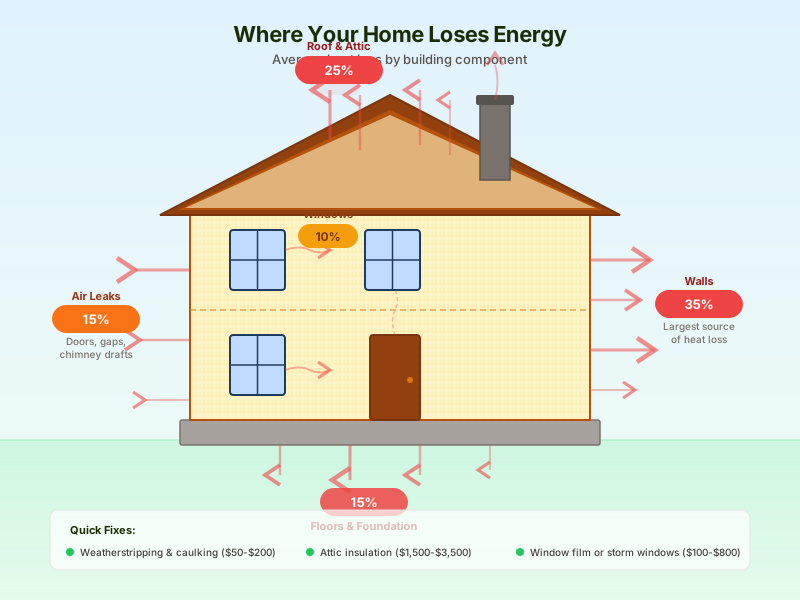
Not all leaks are created equal. Here is where the biggest losses happen, ranked by typical impact.
1. Attic Air Leaks and Insulation Gaps
Your attic is almost certainly the single biggest source of energy waste. Hot air rises, and in winter it pushes relentlessly up through every gap between your living space and the attic. In summer, a scorching attic radiates heat down into your rooms.
The worst culprits are not obvious. Gaps around chimneys, plumbing stacks, recessed can lights, and the attic hatch itself create massive air bypass pathways. You could have a foot of insulation in your attic and still lose enormous amounts of energy through these unsealed penetrations.
What to do: Air seal the attic floor first, then add insulation. Sealing before insulating is critical — insulation without air sealing is like wearing a sweater with holes in it.
2. Rim Joists and Band Joists
Where your foundation meets the framing of your house, there is usually an uninsulated gap called the rim joist or band joist. In basements, you can often see it — it is the wood perimeter sitting on top of the foundation wall. In many homes, it is completely exposed and uninsulated, acting as a highway for cold air.
What to do: Cut rigid foam boards to fit each joist bay, then seal the edges with spray foam. This is one of the best DIY bang-for-buck projects in any home.
3. Ductwork in Unconditioned Spaces
If your heating and cooling ducts run through the attic, crawlspace, or unfinished basement, they are losing 20 to 30 percent of conditioned air before it ever reaches your rooms. Leaky duct connections and uninsulated duct runs are incredibly wasteful.
What to do: Seal duct joints with mastic sealant (not duct tape, which fails over time), then wrap ducts in R-6 or R-8 insulation.
4. Windows and Doors
Old weatherstripping, failed caulking, and single-pane glass all contribute to energy loss. Windows get a disproportionate amount of attention from homeowners, but they are actually lower on the priority list than attic sealing and insulation. Replacing windows for energy savings alone rarely makes financial sense — the payback period is typically 15 to 30 years. If replacement is on your list anyway (for comfort, noise, or a tired single-pane home), see our picks for the best energy-efficient windows in 2026.
What to do: Replace worn weatherstripping, re-caulk gaps, and consider window insulation film for single-pane windows. These low-cost fixes capture most of the available savings.
5. Walls
Wall insulation is harder to address in existing homes because the cavities are enclosed. Homes built before 1980 may have no wall insulation at all. If your walls feel cold to the touch in winter, that is a strong signal.
What to do: Retrofit wall insulation requires a professional who drills small access holes and blows in cellulose or fiberglass. It costs $3,000 to $8,000 for a typical home but saves $400 to $600 annually.
The DIY Weatherization Playbook
You do not need a contractor for most weatherization work. Here is a priority-ordered list of projects almost anyone can tackle in a weekend or two.
Air Sealing: The $200 Project That Saves Hundreds
Air sealing your home is the single highest-ROI energy upgrade you can make. A DIY air sealing project costs $100 to $350 in materials and can cut heating and cooling costs by 10 to 20 percent.
What you need:
- Caulk and caulk gun for small gaps (under 1/4 inch)
- Expanding spray foam like Great Stuff Gaps & Cracks for medium gaps (1/4 to 3 inches)
- Rigid foam board for large openings (cut to fit, seal edges with foam)
- Weatherstripping for doors and windows
- Foam gaskets for electrical outlets and switch plates on exterior walls
Where to seal (in priority order):
- Attic penetrations — around plumbing pipes, electrical wires, chimneys, recessed lights, and the attic hatch
- Basement rim joists — where the house framing meets the foundation
- Around windows and doors — re-caulk any gaps, replace worn weatherstripping
- Electrical outlets and switches on exterior walls — install foam gaskets behind the cover plates
- Where pipes and wires penetrate walls and floors
Pro tip: Do the attic work in cool weather. Attics are unbearable in summer and the caulk and foam cure better in moderate temperatures.
Adding Attic Insulation
If your attic insulation is below the recommended R-value for your climate zone, adding more is straightforward and highly cost-effective. Upgrading from R-19 to R-49 in a 1,500-square-foot attic costs $500 to $1,200 in materials and saves $200 to $400 per year — a 2 to 4 year payback.
Blown-in insulation is the easiest option for most homeowners. Home Depot and Lowe's rent blowing machines for free when you purchase 10 or more bags of insulation. You pour bags into the machine's hopper, point the hose, and fill. It takes a day for a typical attic.
Batt insulation works well for attics with standard joist spacing and no obstructions. Lay new batts perpendicular to the existing insulation to cover the joists and eliminate thermal bridging.
Important: Always air seal the attic floor before adding insulation. Once new insulation is down, you cannot easily access the gaps underneath.
Low-Cost Quick Wins
These take minutes to hours and cost almost nothing:
- Outlet and switch plate gaskets on exterior walls — $10 to $20 for the whole house, 5 minutes per outlet
- Window insulation film like 3M Window Insulator Kit — $5 to $15 per window, good temporary fix for single-pane glass in winter
- Rope caulk for old windows — peel-and-stick, no tools needed, removable in spring
- Door sweeps and draft stoppers — $10 to $30 per door, immediate draft reduction
When to Hire a Professional
Some projects genuinely require specialized equipment, training, or safety precautions.
Spray foam insulation: Requires specialized spray equipment, proper PPE (respirators, suits), and knowledge of expansion rates. Improperly applied spray foam can cause moisture problems and structural issues. Budget $1,500 to $4,500 for rim joists and crawlspaces.
Blown-in wall insulation: Retrofitting wall cavities requires drilling access holes from outside or inside, filling with dense-pack cellulose or fiberglass, and patching. This is a $3,000 to $8,000 job for most homes.
Comprehensive air sealing: A professional equipped with a blower door test can measure your home's exact air leakage rate, then systematically find and seal leaks you would never find on your own. Costs $1,000 to $3,000 but typically reduces air leakage by 30 percent or more.
Crawlspace encapsulation: Involves vapor barriers, drainage management, insulation, and sometimes dehumidification. A significant project at $5,000 to $15,000, but transformative for homes with moisture issues.
Homes with knob-and-tube wiring: Old wiring requires special handling when insulating — standard insulation in contact with knob-and-tube wiring is a fire risk. Hire an electrician to assess and a qualified insulation contractor to work around it.
How to Find a Good Contractor
Start with a home energy audit. Many utilities offer free or subsidized audits that include a blower door test and infrared scan. The auditor will identify your biggest opportunities and can often recommend qualified contractors.
When getting quotes for insulation work:
- Get at least three written quotes
- Ask for the specific R-value that will be installed
- Verify the contractor is insured and experienced with your home's construction type
- Ask about air sealing — a good insulation contractor will address both, not just blow in insulation over unsealed gaps
Costs and Payback: What to Expect
Here is a realistic breakdown of what weatherization projects cost and how fast they pay back:
| Project | DIY Cost | Professional Cost | Annual Savings | Payback (DIY) |
|---|---|---|---|---|
| Air sealing (whole house) | $100–$350 | $1,000–$3,000 | 10–20% of HVAC costs | Under 1 year |
| Attic insulation (to R-49) | $500–$1,200 | $1,500–$3,000 | $200–$400 | 2–4 years |
| Rim joist insulation | $200–$500 | $800–$2,000 | $100–$200 | 2–3 years |
| Weatherstripping all doors | $60–$150 | $300–$600 | $50–$150 | Under 1 year |
| Caulking gaps and cracks | $30–$80 | $250–$750 | $50–$100 | Under 1 year |
| Wall insulation (retrofit) | N/A (pro only) | $3,000–$8,000 | $400–$600 | 5–8 years |
Climate zone matters enormously. A homeowner in Minnesota (Zone 6–7) will save $600 to $1,000 or more annually from comprehensive insulation upgrades. A homeowner in South Florida (Zone 1–2) might save $100 to $200, mostly from reduced cooling costs. Focus your investment where the climate demands it.
Homes heated with oil or propane see the fastest paybacks because those fuels cost more per BTU than natural gas or electricity in most markets.
Rebates and Incentives in 2026
The Big Change: Federal Tax Credits Are Gone
If you have been reading about the 30 percent federal tax credit for insulation (Section 25C), here is the critical update: that credit was eliminated in July 2025 by the One Big Beautiful Bill Act. Projects completed after December 31, 2025 no longer qualify.
If you completed insulation or weatherization work in 2025, you can still claim the credit on your 2025 tax return (up to $1,200 for insulation and air sealing materials plus labor).
What Is Still Available: IRA Rebate Programs
The good news is that two major rebate programs funded by the Inflation Reduction Act survived and are actively rolling out across states:
Home Efficiency Rebates (HOMES Program): Up to $4,000 for achieving 20 percent or greater energy reduction through whole-home retrofits, or up to $8,000 for 35 percent or greater reductions. Available to all income levels, though low and moderate income households get higher amounts.
Home Electrification and Appliance Rebates (HEAR): Up to $1,600 specifically for insulation and air sealing. This program is income-qualified, primarily serving households under 150 percent of area median income.
These programs are launching on different timelines state by state. Some states like North Carolina and Connecticut have already launched. Others are rolling out through 2026. Check your state energy office website for current availability and application details.
Utility Rebates and Programs
Many utilities offer their own incentives independent of federal programs:
- Free or subsidized energy audits with blower door testing
- Insulation rebates ranging from $200 to $1,000 or more
- On-bill financing for efficiency upgrades
- Low-income weatherization through the federal Weatherization Assistance Program (WAP), which provides free weatherization for qualifying households and is unaffected by recent tax credit changes
Call your utility or check their website for current offerings. These programs change frequently but are often generous.
Choosing the Right Insulation Material
Fiberglass Batts
The most common and affordable option. Owens Corning R-15 Fiberglass is the most widely trusted brand (pink batts, available at every big-box store). Good for open attics and standard wall cavities. Easy to install yourself.
Best for: Attic floors, open wall cavities in new construction, budget-friendly upgrades.
Stone Wool (Rockwool)
Premium option that offers higher R-value per inch (R-4.0), fire resistance, water repellency, and excellent soundproofing. Rockwool Mineral Wool Insulation is the leading product. Costs more than fiberglass but performs better in nearly every category.
Best for: Walls, areas near heat sources, anywhere fire resistance or soundproofing matters.
Blown-In Cellulose
Made from recycled paper treated with fire retardant. Fills irregularly shaped cavities well and provides good air sealing properties. Cost-effective for attics and retrofit wall cavities.
Best for: Attic top-ups (great for DIY with rental blower), enclosed wall retrofits (professional dense-pack).
Spray Foam
Closed-cell spray foam provides the highest R-value per inch (R-6.0 to R-6.5) and doubles as an air barrier. Open-cell is cheaper and good for sound control. Both require professional installation.
Best for: Rim joists, crawlspaces, cathedral ceilings, anywhere you need insulation and air sealing in one step.
Rigid Foam Board
Excellent for basement walls, exterior wall sheathing, and sealing large attic bypasses. XPS (blue or pink boards) and polyiso (foil-faced) are the most common types.
Best for: Basement walls, rim joist DIY projects, large gap sealing.
A Step-by-Step Weatherization Plan
If this all feels overwhelming, here is a simple order of operations:
Phase 1: Quick wins (this weekend, under $200)
- Install foam gaskets on all exterior wall outlets and switches
- Caulk visible gaps around windows, doors, and baseboards
- Replace worn weatherstripping on exterior doors
- Add window insulation film to any single-pane windows
Phase 2: High-impact DIY (next weekend, $200–$500)
- Air seal the attic floor — foam around all penetrations, seal the attic hatch
- Insulate rim joists in the basement with rigid foam and spray foam
- Seal around any duct penetrations in unconditioned spaces
Phase 3: Major upgrades ($500–$3,000)
- Add blown-in attic insulation to reach your climate zone's recommended R-value
- Seal and insulate accessible ductwork
- Consider a professional energy audit to identify remaining opportunities
Phase 4: Professional work (if needed, $3,000–$10,000+)
- Blown-in wall insulation for older homes
- Crawlspace encapsulation
- Spray foam for difficult areas
You do not have to do everything at once. Phase 1 and 2 alone will make a noticeable difference in comfort and bills, often within the first month.
The Bottom Line
Insulation and weatherization are not exciting. Nobody posts about caulking their attic on social media. But dollar for dollar, hour for hour, nothing else you can do to your home saves as much energy as sealing air leaks and adding insulation.
A few hundred dollars of DIY air sealing pays for itself in months. Attic insulation pays for itself in a few years. And every other energy upgrade you make later — heat pumps, smart thermostats, solar panels — works better because your home holds onto the energy it produces.
Start with air sealing. Start this weekend. Your next energy bill will thank you.
Related Articles
Installer quotes
Ready to get quotes from local installers?
Compare prices from vetted installers in your area. It takes two minutes, costs nothing, and there's no obligation to move forward.
Savings Tool
Estimate how much your electric bill could actually drop
Model a mix of efficiency upgrades, rate-plan savings, and an upfront budget so you can see what a realistic bill-reduction plan might look like before you buy equipment.
Keep learning
Get the next practical clean energy guide in your inbox
We send focused, consumer-friendly advice on costs, comparisons, and what to do next.
No spam. Unsubscribe anytime.
Reviewed By Watt Wise
Consumer-first clean energy guidance
Watt Wise publishes practical explainers for homeowners, renters, and EV drivers making real decisions about efficiency, costs, incentives, and energy savings.
Focus
Costs, tradeoffs, and what to do next.
Approach
Plain language over sales copy or jargon.
Standards
Updated as pricing, incentives, and rules change.
Editorial Methodology
How this efficiency guide is maintained
Watt Wise guides are built to help readers understand real-world costs, tradeoffs, and next steps before they spend money. We update time-sensitive pages when incentives, utility rules, pricing, or product availability materially change.
What we look at
Costs, compatibility, warranties, utility rules, incentives, and where common buyer mistakes happen.
Update status
Published and monitored for material changes.
Next Reads
Keep the research moving
Related guide
How to Cut Your Electric Bill in Half
The average US electric bill hit $163/month in 2026. 12 proven strategies, ranked by cost, to cut it in half — starting with free changes.
Related guide
Attic Insulation Guide
Complete guide to attic insulation: recommended R-values by climate zone, blown-in vs batts, costs, DIY tips, payback periods, and available rebates.
Related guide
DIY Air Sealing Guide
Step-by-step guide to finding and sealing air leaks in your home. Common leak locations, materials, costs, and how much you can save on heating and cooling.